Tuesday, May 14, 2013

More on Foreign Aid

Following up on my post earlier today, there's a new book by Christopher Coyne of the Mercatus Center on alternatives to traditional foreign aid. I can't say I've read it, but the description complemented the AEI video well enough that it seemed appropriate for posting tonight:

"In place of the dominant approach to state-led humanitarian action, this book offers a bold alternative, focused on establishing an environment of economic freedom. If we are willing to experiment with aid—asking questions about how to foster development as a process of societal discovery, or how else we might engage the private sector, for instance—we increase the range of alternatives to help people and empower them to improve their communities. Anyone concerned with and dedicated to alleviating human suffering in the short term or for the long haul, from policymakers and activists to scholars, will find this book to be an insightful and provocative reframing of humanitarian action."

AEI on Poverty and Growth - Video

"How do you take down poverty? One toy block at a time. "


In this video, AEI explores the impact of a for-profit business setting up shop in an impoverished third-world country, and makes a persuasive case that economic growth inevitably does more to lift up the poor of such countries than one-time donations or aid grants can ever do.  More on AEI's work in this area here: http://www.aei.org/module/1/economic-growth.

Tuesday, May 7, 2013

Free Breakfast

Another good example of feel-good policies with bad results:
The Los Angeles Unified School District (LAUSD) announced last week that it will discontinue the free-school-breakfast plan it initiated last year.
Called "Food for Thought," the plan provides school breakfasts to about 200,000 students.
It was funded by the LAUSD and the non-profit Los Angeles Fund for Public Education, whose goal is to raise the number of participants to about 450,000 students (out of a total of 645,000 in the entire district).
***
Virtually everything the Left touches is either immediately or eventually harmful. The free-breakfast program is only one, albeit a particularly dramatic, example.
Why, then, do progressives advocate it? Because it meets three essential characteristics of the left wing: It strengthens the state; it has governmental authority replace parental authority; and, perhaps most important, it makes progressives feel good about themselves. The overriding concern of the Left is not whether a program does good. It is whether it feels good.
Read the column to find out how this program missed the mark, and to benefit from Dennis Prager's insights on the classic errors of progressive programs.

Wednesday, April 10, 2013

Incentives and Poverty

I've seen two good pieces lately on the impact of government incentives on the poor.  In the first, Abby McCloskey of AEI raises the work of Aspen Gorry and Sita Slavov (also of AEI) on high marginal tax rates as government benefits are phased out:
The tax code should incentivize work, not discourage people from earning a paycheck. Gorry and Slavov recommend transitioning to a proportional tax system to improve transparency and eliminate the variation in marginal and average tax rates within income groups. The system could be made progressive by adding a universal transfer payment or an income exemption.
In the second, Jonah Goldberg highlights the increasing number of Americans receiving disability benefits, with most who go on the disability rolls staying there forever:
That points to the even bigger parts of the story. As the nature of the economy changes, disability programs are sometimes taking the place of welfare for those who feel locked out of the workforce and state governments are loving it. States pay for welfare, the feds pay for disabilities.

Both pieces are worthwhile.  Liberals are good at coming up with well-intentioned policies.  Conservatives are especially strong on how government policy affects incentives.  We have seen this in the way that lower tax rates on work and investment spurred growth in both areas (to the tremendous benefit of all Americans) between 1983 and 2008.  (We can leave for another blog what wound up derailing that growth.)  Conservatives need to keep focusing on how government policy causes and reinforces poverty.  Staying on welfare or on disability is no way out of poverty, no way to live, and no way to contribute to society, but many will do it if it is provided as the easy path forward for them.

Tuesday, April 2, 2013

Regulation and Unemployment

It's not just the cost of wages that depresses employment, as discussed in my last post.  It's also the cost of regulation, which increases for an employer with each new employee. 
Jobs exist for a simple reason. A job is created when a person is willing to do a task for less than the amount of money that labor can earn the employer. It is that simple. Employers are not interested in providing health care, life insurance, maternity or paternity leave, helping to correct past discriminatory behavior, or otherwise affecting social change. The employer wants a task done for a lower cost than what the output produced is worth. If the employer cannot make a profit through the addition of that employee, the employer will not hire the person. That is basic Economics 101.
In situations where a prospective employee is willing to work for less than the profit that she could earn the employer, there is room for negotiation with each party hoping to capture a larger share of the profit being produced. The problem with forcing employers to address social problems through employee benefits is that the cost of those benefits reduces the room for negotiation. As the cost of all these benefits (paid leave, health insurance, etc.) adds up, at some point there is no room left and the person does not get hired.
People with good intentions, thinking they are making the world a better place, have added so many mandatory benefits to the cost of an employee that companies are looking for any alternative to hiring more employees. Companies strive to produce and sell more each year while simultaneously reducing their number of employees. Doing more with less is the mantra of the day.

That's from Jeffrey Dorfman on Real Clear Markets, and he's exactly right.  Once again, well-meaning statists come up with programs to help people, motivated either by genuine desire to help or a more cynical desire to create political advantage.  The programs wind up helping some, but the net impact on society is negative.  Unfortunately, these programs can't be undone, because we're so focused on purported motives instead of actual results.  Conservatives need to shift the focus back to results.

Monday, March 18, 2013

Minimum Wage

Life is getting in the way of blogging with more and more frequency.  So I'm going to try quicker posts, in the hope I can get more up, more regularly.  President Obama's recent call for an increase in the federal minimum wage is a good topic with which to start.  Most conservatives and, as I understand it, most economists believe that an increase in the minimum wage will have some negative impact on employment.  Want less of something?  Make it more expensive.  That is true of a variety of things, including labor.

Of course, most of us want poorer workers to receive more for their labor.  We can imagine how difficult it is to live off the minimum wage.  It makes us feel bad to think of their plight.  And these feelings are good.  I likely wouldn't have started this blog if some emotional response to others' poverty didn't trigger my wanting to think through the issue.

But as my first post said, one of my operating principles here is that we don't help the poor just by feeling bad, and we don't help them by doing things that make us feel better.  We help by doing things that actually, you know, help.  Raising the minimum wage makes us feel good, and it helps those who keep their minimum wage jobs, but it seems likely to drive down employment in our country and unmistakably sends jobs to other countries with lesser wage regulation.

One fears that this is just another wedge issue for the President, rather than a real legislative goal.  That's harmless as far as it goes, but it distracts from measures that could really help the poor (and everyone else).

Here are some recent conservative responses to calls for a minimum wage increase, with an emphasis on its impact on the poor:

Mark J. Perry - AEI

John Fund - NRO

As Fund and even former Obama advisor Christina Romer (whom he quotes) suggest, the real way to help the poor is to promote economic growth, not to monkey around in the labor markets.

Wednesday, March 6, 2013

More on the Politics of Conservatism and Poverty

Life has been getting in the way of blogging for me, but conservative commentary on poverty continues.  Two good columns on the topic were published Monday.  Arthur Brooks of the American Enterprise Institute advanced a theory in the Wall Street Journal that's gotten some attention on this blog - namely, that talking about their approach to poverty issues would benefit conservatives politically.  Brooks starts by pointing out the perceived "caring" gap between President Obama and Mitt Romney during the recent presidential campaign, and then writes:
Conservatives are fighting a losing battle of moral arithmetic. They hand an argument with virtually 100% public supportcare for the vulnerableto progressives, and focus instead on materialistic concerns and minority moral viewpoints.

The irony is maddening. America's poor people have been saddled with generations of disastrous progressive policy results, from welfare-induced dependency to failing schools that continue to trap millions of children.
The column was an outgrowth of ideas set forth in Brooks' terrific 2012 book, The Road to Freedom.

Also on Monday, Matt K. Lewis wrote in The Week that conservatives are too quick to seek to be the opposite of President Obama at each turn, reactively embracing "radical individualism" and "selfishness" in response to his collectivism and plans to redistribute wealth.  Instead, Lewis writes, conservatives should embrace the "compassionate" wing of their camp, as the founders did:
Our founders believed self-imposed responsibility was essential to the preservation of freedom. An immoral majority will eventually discover that they can vote "themselves largess from the public treasury." But a nation's elite must also be moral which is to say, not greedy. As Ed Morrissey noted, "Any society with a large class of exploited poor will have no end of social difficulties and instability, the costs of which in a properly ordered system would far exceed the assistance extended." That's the invisible hand at work.

Compassion isn't just right. It's also a matter of self-preservation.
Lewis seems to agree with Brooks (and me) that conservatives not only do right, but also benefit politically, by talking about poverty, evincing concern for the poor, and advancing the idea that conservatism is best for all 100% of our countrymen.

Wednesday, February 6, 2013

Government Spending, Jobs, and Poverty

Here's an interesting US News article by Keith Hall of the Mercatus Center at George Mason University.  Hall argues that, if we are interested in fighting poverty, the focus should be on increasing economic growth and employment, not government spending.  Record spending since the dawn of the most recent recession has not prevented record rates of poverty.  Meanwhile, "[i]t has been long recognized that recessions can increase the number of families in poverty, and over the past 20 years it has become clear that the rising and falling poverty rate correlates directly with the jobless rate."  Hall provides this graph in support of his proposition:
That's tough to argue with.  If government wants to reduce poverty, it must create jobs - or, more accurately from a conservative's perspective, reduce the impediments to job creation.  If that's the case, we should question whether increases in tax rates, including those offered to support anti-poverty spending programs, actually increase poverty by inhibiting job growth.  We should highlight that regulations that retard economic growth and/or reduce the incentive to hire (Obamacare?) have the indirect effect of increasing poverty.  In short, liberals should be made to defend their programs against the possibility that they actually increase poverty, by depressing employment.

Thursday, January 31, 2013

The Politics of Poverty

Mona Charen wrote a convincing article for National Review Online last week on the political upside for Republicans to talking about poverty.  Of course, she's a conservative who believes conservatives have the right answers on poverty, but the unique insight here is on the politics of the issue.  Her conclusion:

[Paul] Ryan is right to see an opportunity for Republicans in talking about poverty. It might improve the Republican brand in the eyes of all voters. It opens a door to talk about the best anti-poverty program economic growth, which has been conspicuously absent under Obama. It also highlights a fact the Democrats want to bury: All Americans are poorer as a result of Obama’s policies, but the poor are hit hardest.
The article begins and ends with references to Paul Ryan, seemingly the conservative standard-bearer on poverty (and a lot of other issues) right now.  I wrote about his attention to the issue in my first post on this blog.

What I think Charen hints at, but doesn't spend enough time on (perhaps because of space constraints), is that Republicans can use the issue of poverty to win votes, even if they don't win the votes of the poor.  It's going to take an awful lot of work before we change our culture and educate voters to the extent that the poor will vote against hand-outs in favor of economic growth (and the socio-economic mobility and opportunity that come with growth).  I think it will take a lot less work to change the attitudes of voters in other classes when it comes to anti-poverty policies.

My sense is that there are many upper- and middle-class voters who vote against Republicans because they feel charitable toward the poor when they vote for Democrats.  For some, there's a genuine belief that Democrat policies are better for the poor, and that group is going to be difficult to persuade otherwise.  For others, however, there's an uneasiness with Democrat policies (especially no-strings-attached hand-outs), but a greater uneasiness with perceived Republican indifference or hostility to the poor.  These voters can be swayed.  Just talking about poverty would peel off some of the votes Democrats typically receive by swing voters concerned about the poor.  Indeed, I think a sustained push by Republicans just to talk about poverty would astonish a lot of these voters - in a very positive way!  Talking about it persuasively - that is, making the case that Republican policies increase upward mobility and provide a path out of poverty, instead of mere hand-outs - would certainly peel off even more voters.

Conservatives should fight the good fight on poverty because it is a good fight, not because it is a political winner.  But I do believe it is a political winner, and for better or worse, only that argument can convince Republican politicians to talk about it.  So, we should make it.

Incidentally, Charen wrote a book about 10 years ago that struck a chord with me by synthesizing and articulating some ideas that only had been rattling around in my head in my younger years.  Do-Gooders: How Liberals Hurt Those They Claim to Help provides example after example of the ways in which liberal policies purportedly (often genuinely) designed to help the poor instead have the opposite effect.  That's certainly one of the insights I hope to explore in this blog.  Kudos to Charen for keeping up the good work.

Monday, January 28, 2013

Kudos to the President

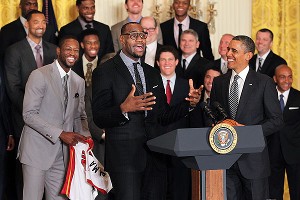
Today, President Obama hosted the Miami Heat in the White House, in celebration of their 2012 NBA Championship.  He did something I have faulted him for not doing - highlighting the impact a good father can make, particularly in the black community.  The President did not belabor the point, nor did he make it an explicitly racial or socioeconomic issue, and given the setting, his approach was entirely appropriate.  Still, the implication was clear, in view of the NBA's dominance by young black men and the somewhat checkered history of NBA players with fatherhood. 


I hope this is just the start of the President's efforts to raise awareness of the issue.  His comments today, alone, might not do much.  With some repetition, he might develop some momentum for the issue.  As I've written before, he is uniquely positioned to do this.

Here's the story.

Wednesday, January 23, 2013

What It Means to be Poor

From time to time, I've had occasion to take the Market-Frankford "El" (an elevated train line in Philadelphia) from Center City to the line's final destination in West Philadelphia - 69th Street Station.  The El runs through some of the poorer neighborhoods in Philadelphia on that ride, and I've noted the mini-satellite dishes (undoubtedly for Direct TV or Dish Network) that pepper the roofs of row homes visible from the train.  They're all over the place out there.  I'm not foolish enough to think that means the occupants of those homes are rich or even comfortable, and I certainly don't begrudge anyone their dishes.  But it has made me wonder about what it means to be poor in the 21st century.  If even the poor can afford satellite TV, poverty can't be quite as uncomfortable as it was 50 or 100 years ago.

I've had similar thoughts about food, and clearly I'm not alone here.  Repeated surveys and studies make clear that poor people are more likely to be overweight than those in other economic classes.  Again, that doesn't mean it's good or easy to be poor; indeed, the limited food choices faced by the poor seem to contribute to this problem.  But, poverty used to imply struggling to "put food on the table."  Now, things seem different.

One of my favorite bloggers, Jim Pethokoukis of the American Enterprise Institute, posted yesterday on a new study suggesting that we may be winning the war on poverty, at least more than we think:
[M]oving from traditional income-based measures of poverty to a consumption-based measure (which is arguably superior on both theoretical and practical grounds) and, crucially, accounting for bias in the cost of living adjustment leads to the conclusion that the poverty rate declined by more than 25 percentage points between 1960 and 2010, with 8.5 percentage points of that decline occurring since 1980.
Pethokoukis explores the work of Bruce D. Meyer and James X. Sullivan more than I will here.  The gist is that the poorest among us are living at a higher standard than income-based measures might suggest, at least in part because of the impact of tax subsidies and transfer payments.


The work of Meyer and Sullivan makes a point different from the one I drive at above, but I think the questions they seek to answer are similar to mine.  While the typical government/academic approach is to focus on wealth inequality and an arbitrary "poverty level," it might be more helpful to understand how the poor actually live, how that might be changing, and to what end government policy should try to improve their condition.  To the extent poverty in 2013 presents challenges different from those faced by the poor of 1963, we should acknowledge and address that - even if it means some uncomfortable discussions and some changes in approach.  That's tougher work for bureaucrats, but I can't say that angle concerns me much.

Thursday, January 17, 2013

Fatherlessness and Guns

This blog isn't going to focus on gun violence and gun laws.  Still, it's the public policy topic of the day, it's related to poverty to some degree, and there's a powerful new column on the relationship of gun violence and one of the themes of this blog to date - fatherlessness.  The column is by Lee Habeeb on National Review Online.  A few excerpts:
As we continue to hear calls for ever-tightening gun laws from the Obama administration, and from states such as New York, it is worth thinking about those headlines in Chicago. And in inner cities all around America, places where strict gun laws are already in place. Places where the weapon of choice isn’t an AR-15 but a semiautomatic handgun — the same kind of weapon most Americans use reasonably, and safely, to secure their most precious assets: their loved ones and their property.
***
In Chicago, it’s Newtown every month. But the media haven’t converged on Chicago this month.
You don’t know the names of those kids and adults gunned down in Chicago this January, all by handguns. But the Chicago Tribune’s RedEye website tracks the Chicago body count since January 1: Gregory Bady, 28; Damian Barnes, 22; Marcus Wallace, 23; Tyrone Soleberry, 39; Brian Cross, 34; John Taylor, 23; Darville Brown, 24; Tyshawn Blanton, 31; Marcus Turner, 19; Lavonshay Cooper, 22; David Bartzmark, 25; Michael Kozel, 57; Ulysses Gissendanner, 19; Kevin Jemison, 29; Myron Brown, 30; Devanta Grisson, 19; Octavius Lamb, 20.

***
You don’t know their names because the real racism that exists in the media is this: A young black male’s life is not worth reporting when it is taken by another black male.
***
You don’t know the names because the media don’t or can’t blame the deaths in Chicago on a weapon like the AR-15, or on the NRA.
You don’t know their names because the media aren’t interested in getting at the real cause of much of the senseless gun violence in America: fatherlessness.
About 20,000 people live in my hometown of Oxford, Miss., and there are probably twice as many guns. Folks own handguns, shotguns, rifles, and all kinds of weapons I’ve never even heard of. But I can’t remember the last murder story in the local paper.
That’s because my town has lots of guns, but lots of fathers, too.
Chicago doesn’t have a gun problem; it has a father problem.
Gun control isn’t the problem on Chicago’s streets; self-control is.
When young men don’t have fathers, they don’t learn to control their masculine impulses. They don’t have fathers to teach them how to channel their masculine impulses in productive ways.

***
So why don’t the media focus on the epidemic of fatherlessness in our inner cities and on the tragic consequences for boys? The mostly white liberal editors and gatekeepers of the mainstream media would never admit that liberal policies of the 1960s have had disastrous consequences. They won’t admit that government can’t replace the essential role that marriage and family plays in raising, disciplining, and loving children.
The gun control measures proposed by President Obama yesterday don't seem likely to prevent another Newtown.  I'm mildly in favor of additional regulation on the process for obtaining guns and additional restrictions on the kinds of guns that individuals may own (on the grounds that most such laws won't do any harm and won't inhibit the ability of law-abiding individuals to protect themselves), but I'm largely pessimistic these laws will do much to protect mass shootings - or even the violence Habeeb describes as sadly unexceptional in Chicago. 

On the other hand, who seriously can doubt that more fathers in the homes of poor children would reduce some of the gun violence we see in our innercities?  Too uncomfortable to discuss, though, apparently.

Yesterday was another opportunity for President Obama to speak out on the issue of fatherlessness - another opportunity missed.

Thursday, January 3, 2013

A Conservative(?) for the Welfare State

A blog called "Conservatives on Poverty" wouldn't be worth its salt if it didn't acknowledge a blog post on the New York Times website called "A Conservative Case for the Welfare State."  So here I go.  It's an interesting post - albeit not one I find particularly persuasive or "conservative."
I'd prefer in this blog not to spend too much time questioning motives or backgrounds.  I'd rather focus on the merit of the ideas I explore.  But I'd probably be remiss if I didn't mention, in the course of discussing a "conservative case" for something, that the author isn't necessarily a conservative.  There's no question Bartlett once was.  He was an advisor to Congressmen Paul and Kemp, and he worked in the Reagan and Bush I White Houses.  Sometime in the early 2000s, though, Bartlett and mainstream conservatism seemed to part ways.  He wrote a book in which he criticized the Bush II Administration from a variety of angles, including some I find very persuasive (particularly on spending).  Since then, he has enjoyed some measure of popularity on the left as a conservative critic of the right.  He has advocated a value-added tax and Keynesian stimulus.  Bartlett's own story of his political journey was presented recently in his article in the American Conservative.

Again, the point of this isn't whether Bartlett is generally right or wrong, wise or unwise.  But I think it's worth noting, in the context of his "conservative case," that he may not really be a conservative anymore.

Back to Bartlett's post.  He makes several arguments for why conservatives should embrace a European-style welfare state:
  • It "shaves off the rough edges of capitalism and makes it sustainable," producing greater social harmony.
  • There is no empirical support for the American conservative perspective that the welfare state diminishes happiness.
  • There is empirical support for the efficiency of a "properly run" welfare state - i.e., one in which benefits are nearly universal - because the bureaucracy needed to determine qualification questons and the incentive against work (arising from benefit phase-outs) are both eliminated.
  • When tax expenditures are included in surveys of net social spending, the American system is actually no more efficient than the European system.
I happened to read Bartlett's post on the same day I read Yuval Levin's analysis of the fiscal cliff deal on the Corner over at National Review Online.  Levin makes a powerful case that, whatever merits our entitlement system might have, it is fiscally unsustainable in its current state.  I found Bartlett's arguments either to ignore or to gloss over the sustainability point.  (Or maybe he is leaving them for another day.)  I suppose he might say that the greater efficiency of a "properly run" welfare state would bring spending way down toward tax revenues.  From his earlier writings on the VAT, I suppose he might say he could bring revenues way up toward spending levels (after his efficiencies have been achieved).  I'd like to see the math that brings those levels close enough to be sustainable.  I'd also like to see a projection as to what higher taxation and more universal benefits would do to national economic growth. 

Color me skeptical.  One of my key objections to the welfare state is that it seems impossible to maintain projected benefit levels, increase taxation sufficient to support such benefits, and preserve economic freedom, growth, and prosperity.  Bartlett doesn't convince me otherwise.  (I have a number of other reservations, particularly on the welfare state and true happiness, but Levin's post has me focused on fiscal sustainability.)

Still, it's a worthwhile contribution to the discussion.  Conservatives might argue for an alternative to the welfare state.  As long as we have one, or if we're destined to have one forever, it's worth considering Bartlett's points on bloat and efficiency, if nothing else.